
The difference is focus, not just page count
A landing page guides one visitor toward one outcome. A business website creates several clear paths for people with different questions. Both can be professionally designed, mobile-ready, and visible in search. The choice depends on how much information the decision requires.
| Question | Landing page | Business website |
|---|---|---|
| Best fit | One offer, campaign, event, or profile | A company with several services or information needs |
| Typical structure | One long page with one primary action | Home plus separate service, about, proof, FAQ, or contact pages |
| Visitor journey | Mostly the same for everyone | Different paths for different customers |
| Search coverage | One focused topic | Several distinct topics or service searches |
| Content effort | Smaller, but still needs a complete argument | More material, organisation, and review |
| Future growth | Can become a campaign page or expand later | Easier to add detailed services and resources |
A landing page works when the decision is narrow
One page is often enough when the visitor already has context. They may have clicked an advertisement, scanned a QR code at an event, received your link through WhatsApp, or searched for a very specific service. The page only needs to explain the offer, establish trust, answer the main objections, and make the next action easy.
- A new service or limited campaign
- An event, workshop, waiting list, or registration drive
- A consultant, freelancer, or personal profile with one main offer
- A small business that needs a credible first presence quickly
- A focused lead-generation page connected to an advertisement
A short page is not automatically a good landing page. It still needs specific copy, useful proof, pricing or qualification details where appropriate, common questions, and a clear action. Removing necessary information to keep the page visually minimal usually lowers trust.
Use a business website when visitors need different paths
Separate pages help when a customer wants to investigate the company before making contact. A procurement manager may look for capabilities and company details, while a direct customer may want one service, price guidance, and examples. Giving each need a clear page makes the website easier to scan and easier to share.
- You offer several services that solve different problems
- Customers need projects, credentials, testimonials, or detailed FAQs before enquiring
- Different locations, industries, or customer types need their own explanation
- You want useful search pages for distinct services rather than one broad page
- The company regularly publishes projects, articles, vacancies, or updates
A multi-page site should not split one small amount of content across empty pages. Every page needs a distinct purpose. If the About, Services, and Contact pages only repeat the homepage, a focused landing page may be the stronger first release.
Consider how people will find the page
For advertising, a dedicated landing page can match one campaign closely. The headline, proof, offer, and form can all speak to the audience promised in the ad. Sending every campaign to a general homepage often makes visitors search for the relevant information again.
For organic search, separate pages can help when they genuinely answer different searches, such as office renovation, retail renovation, and design consultation. More pages do not create rankings by themselves. Each page needs distinct, useful content and a clear place in the site's navigation.
Match the first release to your available content and budget
A landing page usually costs less because there are fewer layouts, less content, and a smaller testing surface. A business website adds value when the extra pages answer real customer questions, but those pages also need writing, images, review, and future updates.
If the budget is tight, prioritise the smallest complete journey. A strong one-page site is better than five unfinished pages. Plan the structure so important services can become their own pages later without rebuilding the entire site.
If the business already has detailed service material, strong project images, and several customer groups, forcing everything into one page can make it difficult to navigate. In that case, the larger structure earns its cost from the start.
Examples for common Malaysian businesses
A home-based baker promoting one festive preorder can use a landing page with product options, order dates, delivery areas, proof, and a WhatsApp order action. A bakery with daily products, custom cakes, wholesale supply, outlets, and careers will benefit from separate pages.
A freelance trainer running one upcoming workshop can use a landing page with the agenda, trainer profile, fee, venue, FAQs, and registration. A training company serving corporate teams across several programmes needs a business website so buyers can compare programmes and review company credentials.
A renovation contractor offering one specialist service in one area may begin with a landing page. A design-and-build firm covering residential, retail, and office work needs separate service and project paths because the evidence and customer questions differ.
Use this decision checklist
Choose a landing page if most of these statements are true:
- We have one main audience and one offer.
- Visitors need roughly the same information before acting.
- One enquiry, registration, or purchase action matters most.
- We need a focused first release and can add pages later.
Choose a business website if most of these statements are true:
- We have several services, audiences, or customer journeys.
- Customers need detailed proof or company information before contact.
- Different services deserve their own useful search pages.
- We already have enough content to support distinct pages.
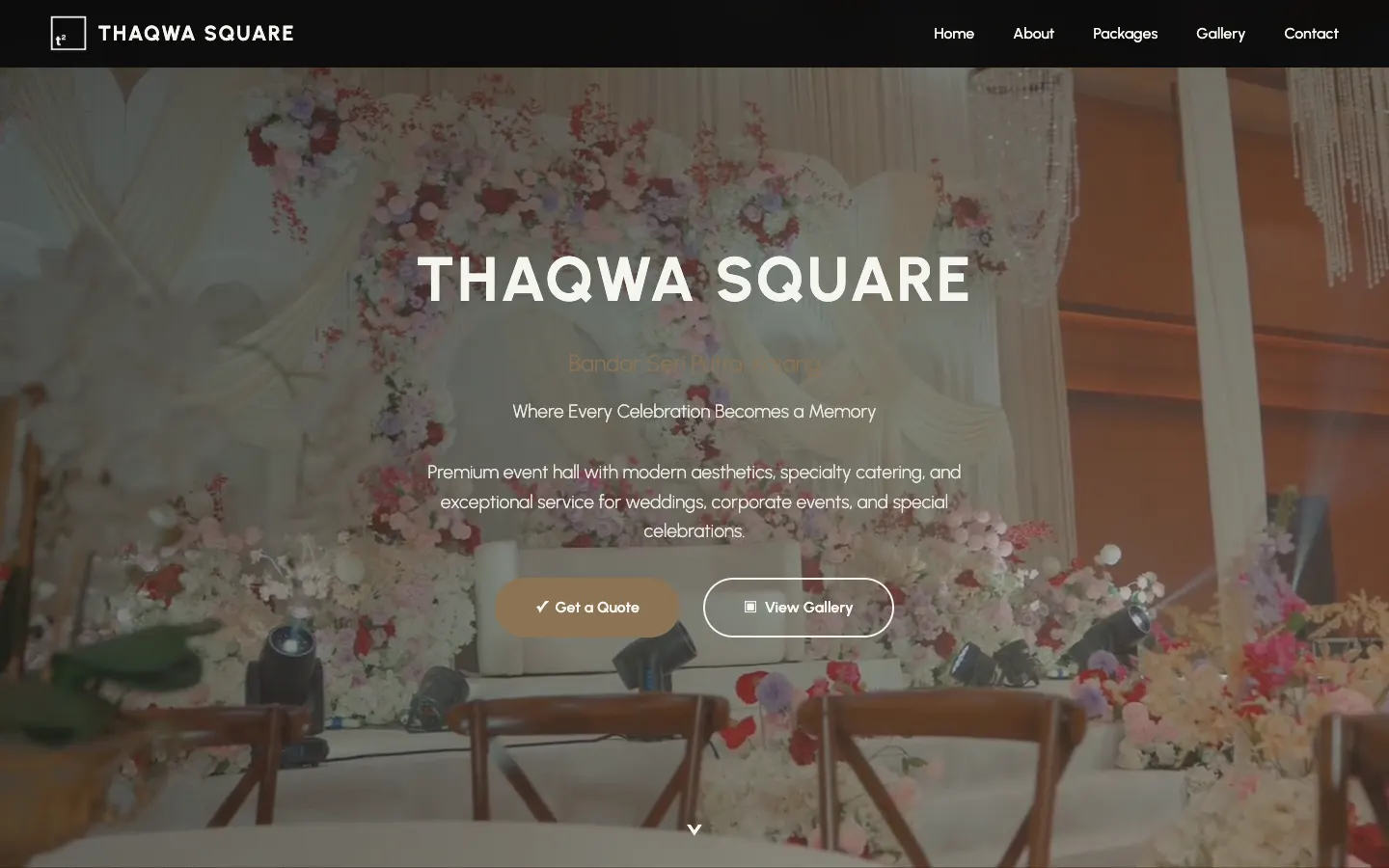 Project story · 5 min readThaqwa Square: a wedding hall website that turns browsing into WhatsApp quotes